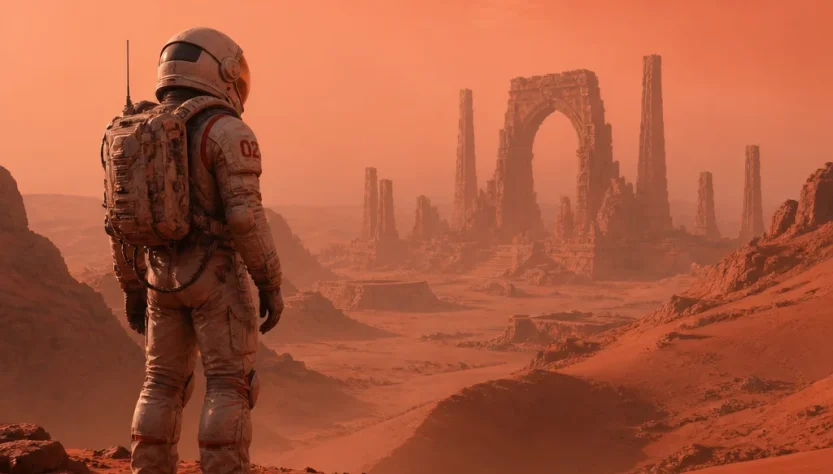
No celestial body in our solar system has shouldered as much literary weight as Mars. Suspended in the night sky as a rust-coloured promise, it is close enough to be mapped through a telescope yet distant enough to absorb every human projection—fears of imperial collapse, anxieties about ecological ruin, and dreams of endless expansion. For well over a century, novelists and short-story writers have treated the red planet as a blank canvas. The resulting body of work is so massive and influential that Martian fiction effectively functions as a distinct sub-genre within science fiction.
What makes the trajectory of Mars in literature fascinating is that its foundation rests on a historic translation error. In 1877, Italian astronomer Giovanni Schiaparelli mapped the planet, labeling dark surface features canali—which translates to natural channels. English-language readers and science popularizers rendered this as \”canals,\” and wealthy American astronomer Percival Lowell seized upon the mistranslation. Lowell spent decades arguing that these were artificial waterways engineered by an ancient, dying civilization fighting to survive on an evaporating world. That single linguistic slip midwifed one of science fiction’s most resilient tropes: the advanced, melancholic alien race confronting planetary extinction.
Early Visions: From Swift to the Canal Builders
Mars entered speculative literature long before Schiaparelli peered through his telescope. In Jonathan Swift’s 1726 masterpiece, Gulliver’s Travels, the astronomers of Laputa accurately catalogue two moons orbiting Mars—Phobos and Deimos—roughly 150 years before Asaph Hall officially discovered them in 1877. This curious literary coincidence established a persistent tradition: Mars as a stage where writers stake scientific claims before astronomers can verify them.
As the twentieth century dawned, the canal hypothesis gave Mars a definitive topography of deserts, shrinking polar caps, and vast engineering projects. While astronomers argued in academic journals over spectral analysis, fiction writers treated Lowell’s claims as a prompt. The planet evolved into a narrative pressure cooker where water equaled survival and the lack of it signaled civilizational decline.
H. G. Wells and the Invasion Blueprint
H. G. Wells’s 1898 masterwork, The War of the Worlds, did more than any other text to cement Mars in the public consciousness, establishing a blueprint that modern alien-invasion stories still follow. Wells inverted the colonial gaze: rather than sending a European explorer to subjugate an alien world, he dispatched desperate Martians to Earth. They arrived as technologically superior colonists with zero interest in diplomacy, driven purely by resource scarcity.
Wells was equally revolutionary in his depiction of humanity’s vulnerability. His narrator watches the British Empire—then the undisputed apex of terrestrial power—shatter in a matter of days. Crucially, the invaders are defeated not by human military valor, but by mundane terrestrial bacteria against which they possess no immunity. This narrative pivot taught generations of writers that nature is entirely indifferent to human hubris. Every modern sci-fi story featuring survival against insurmountable odds owes a direct debt to Wells.
Edgar Rice Burroughs and the Planetary Romance
If Wells provided existential dread, Edgar Rice Burroughs delivered unbridled swashbuckling adventure. Serialized in 1912 and published as A Princess of Mars in 1917, the novel transported Confederate veteran John Carter to Barsoom—Burroughs’s vibrant, scientifically impossible vision of Mars. It was a world of four-armed green warriors, feuding red city-states, desperate airship dogfights, and captive princesses.
Burroughs codified the planetary romance. His Barsoom books established the grammar of sword-and-planet fiction: the exotic desert frontier, ancient ruins concealing lost technology, rigid warrior cultures governed by labyrinthine codes of honor, and the displaced Earthman who disrupts local feudal politics. Later writers often pretended to disdain Burroughs while eagerly plagiarizing his structural mechanics. The archetype of Mars as a wild frontier of duels and dynasties originates right here.
A Socialist Mars: The Russian Tradition
Anglophone writers did not hold a monopoly on the red planet. In 1908, Russian physician and philosopher Alexander Bogdanov published Red Star, a utopian novel wherein an Earth revolutionary travels to a Martian society organized along collective, socialist principles. Bogdanov’s Mars is technologically post-scarcity, rationally managed, and morally advanced, serving as a satirical mirror designed to expose the backwardness and injustice of early twentieth-century capitalism.
This utopian strain became a permanent fixture of Martian literature. Whenever a writer uses the planet as a tabula rasa to redesign human social, economic, or political structures free from legacy laws and historical grievances, they are channeling Bogdanov. Whether the resulting society is a cooperative commune, a corporate technocracy, or a federated republic, the premise remains identical: Mars is the ultimate laboratory for constitutional design.
Bradbury, Lewis and the Poetic Mars
Ray Bradbury’s 1950 linked collection, The Martian Chronicles, approached the planet not as a physical destination, but as a psychological mirror. Bradbury’s Mars is a melancholic stage reflecting the American frontier myth, systemic racism, and ecological destruction. His Martians are fragile, telepathic, and ultimately doomed; his human settlers are nostalgic, destructive, and deeply alienated. Bradbury replaced hard-science plausibility with lush, elegiac prose.
C. S. Lewis pursued a theological trajectory in his 1938 novel Out of the Silent Planet. His Malacandra is an unfallen eden inhabited by three distinct rational species living in cosmic harmony, forcing his terrestrial protagonist to confront the moral horror of human colonization from the viewpoint of the native inhabitants.
The Golden Age: Heinlein, Dick and the Psychological Frontier
Mid-century masters weaponized Mars for domestic social critique. Robert Heinlein’s Stranger in a Strange Land (1961) introduced Valentine Michael Smith, a human raised by Martians who returns to Earth as a countercultural messiah, using alien detachment to skewer terrestrial institutions. Philip K. Dick pivoted toward psychological paranoia in Martian Time-Slip (1964), presenting Mars not as a romantic frontier, but as a drab, bureaucratic company town populated by stressed colonists, real estate speculators, and broken minds.
Dick’s cynical vision laid the groundwork for gritty cyberpunk adaptations, most notably his short story “We Can Remember It for You Wholesale,” which evolved into the film Total Recall. By the 1980s, Mars had acquired a dual identity in pop culture: no longer just a realm of ancient ruins, but an industrial mining hellscape squeezed by corporate conglomerates.
Terraforming, Hard Science and the Robinson Era
Kim Stanley Robinson’s monumental Mars trilogy—starting with Red Mars in 1992—elevated the genre through rigorous adherence to geology, climatology, and political science. Robinson’s multi-generational narrative charts the deliberate terraforming of the planet while interrogating who owns an unowned world. The trilogy turned colonization into an exhaustive masterclass in class struggle, economic theory, and environmental ethics.
Decades later, Andy Weir’s The Martian (2011) shifted the focus toward granular, engineering-driven problem-solving. Stranded astronaut Mark Watney survives through botanical improvisation and orbital mathematics. Weir’s massive success reaffirmed a foundational trope: Mars as the ultimate crucible of human competence, where technical knowledge outweighs raw heroism.
The Trope Catalogue: What Mars Taught Science Fiction
Examining a century of Martian narratives reveals a recurring toolkit that writers continually adapt and subvert:
- The dying world and its vanished builders, born from Schiaparelli’s misread maps.
- The invasion narrative, where planetary desperation sparks terrestrial conquest.
- The desert frontier, populated by martial aristocrats and lost technology.
- Terraforming framed as an ideological and political battlefield rather than a mere engineering task.
- The survival puzzle, pitting a lone specialist against a lethal, indifferent ecosystem.
- The colonial outpost as a microcosm of terrestrial inequality, labor exploitation, and property disputes.
- First contact marred by the quiet erasure of indigenous intelligence.
- The fractured identity or implanted memory, inherited from the Dickian psychological tradition.
At the core of all these tropes lies scarcity. Mars offers no breathable air, no standing oceans, and no forgiving weather. Every narrative set there is fundamentally a story about limits. This constraint acts as an incredible narrative engine, generating immediate conflict and stripping characters down to their core values.
Furthermore, Mars serves as an increasingly urgent planetary warning. A world stripped of its atmosphere and rivers functions as a natural climate parable. Contemporary authors utilize dust storms and ruined riverbeds not as generic set dressing, but as a stark commentary on our own ecological trajectory.
Why Mars Still Matters
Mars remains singularly compelling because it represents the only reachable terrestrial world we might realistically inhabit—or ruin. Venus crushes probes in minutes; gas giants offer no solid ground. Mars welcomes footfalls. That proximity forces us to ask uncomfortable questions: What baggage do we carry across the void, what do we leave behind in the dust, and who holds the authority to reshape a world?
The red planet has proven remarkably accommodating to contrasting authorial tones, effortlessly bridging Bradbury’s lyrical melancholy with Weir’s buoyant pragmatism. Writers will keep returning to its rust-colored dunes because the setting permits them to debate colonization, climate crisis, and existential loneliness without ever naming Earth directly.
The canals were never real. The ancient emperors of Barsoom never existed. Yet the literary Mars engineered by translators, astronomers, invader-novelists, and hard-science pioneers has proven far more durable than actual iron oxide. It remains the premier laboratory of science fiction, ensuring that every probe we launch into the void carries a rich cargo of literary history alongside its scientific instruments.
“